

Exploring the Impact of End-to-End Process Design
Executive Summary
This Peeriosity-100 Peercast featured a panel discussion on end-to-end (E2E) process design within Global Business Services (GBS) organizations, focusing on Procure-to-Pay (P2P) and related processes. Panelists from three Peeriosity-100 member companies shared their companies’ journeys toward establishing Global Process Owners (GPOs) and achieving cross-functional process ownership.
The conversation emphasized how E2E process visibility, data-driven decision-making, and cross-functional collaboration improve efficiency, accountability, and customer experience. Key challenges included balancing influence vs. authority for GPOs, breaking down functional silos, and aligning metrics and incentives across departments.
The panel concluded that credibility, data transparency, and executive sponsorship are essential for successful E2E process ownership. Future discussions will continue exploring optimization of E2E design and hybrid work implications for GBS teams.
Note that this document is a summary. Peeriosity-100 members have full visibility to company names, presenters, Peercast attendees, and a recording of the Peercast discussion.
Poll Results Review
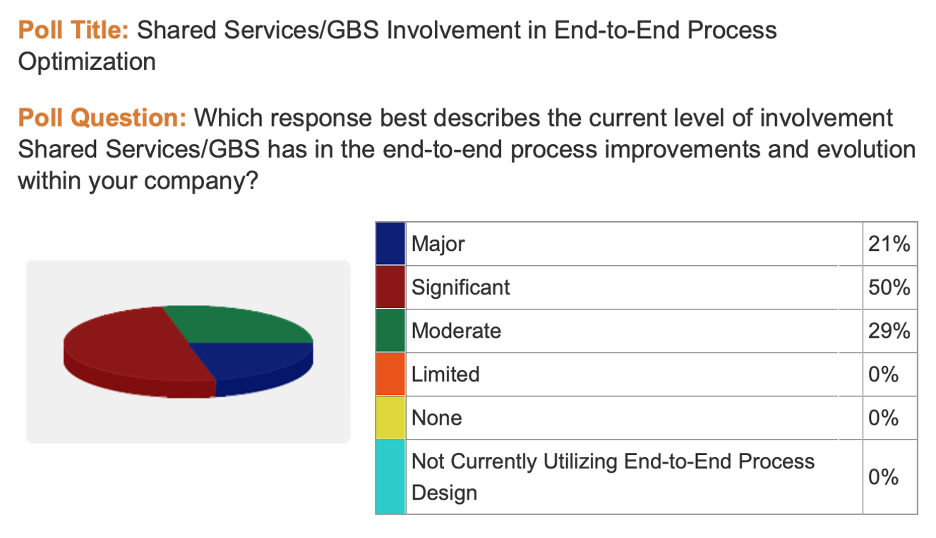
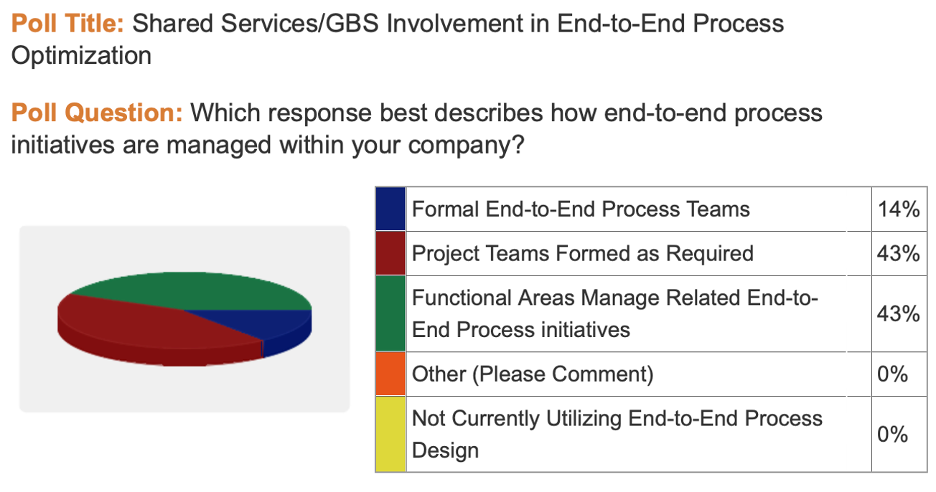
A Peeriosity-100 poll was created to better understand the level of involvement Shared Services/GBS has in end-to-end process optimization, and how end-to-end process improvement initiatives are structured.
Per the chart below, 71% of member companies indicate that the involvement of Shared Services/GBS is either significant or major, with the remaining 29% indicating the level of involvement is moderate. No companies selected the options for “limited”, “none”, or “Not currently utilizing end-to-end process design”.
Regarding how end-to-end improvement initiatives are structured, 43% indicated that functional areas manage related end-to-end process initiatives, and 43% report that project teams are formed as required, with only 14% indicating they have permanent formal end-to-end process teams.
Some comments from members:
- While we would like to have process owners who truly cover end to end processes, ownership is still divided between Operational and Finance activities. For example Order to Cash involves Sales, Order Management and Finance. Sales engages with the customer, Order Management takes the order and Finance issues the invoices, collects and applies the cash. If there are delivery issues that causes the customer to hold off on paying the invoice, Finance contacts sales. If the customer says our sales order does not match their purchase order Finance contacts order management. Issues are addressed one by one and only if a persistent pattern is found, sometimes a formal cross function project is launched to address the issues, but there is never a single process owner.
- As long as it’s a process that is managed and owned by shared services; payroll, invoice processing, procurement, and T&E for example we have significant involvement in the end to end process reviews. Other areas like Treasury, HCM and General Accounting we are more like contributors and can be more flexible with our defined roles.
Key Topics Discussed
- Evolution of End-to-End Process Ownership
- Company A:
-
- GBS established in 2013; initial GPO roles dissolved due to lack of readiness.
- Reintroduced GPOs (P2P, R2R) in recent years, focusing on empowerment and authority.
- Emphasized shifting from a results-oriented to a process-oriented culture.
- Company B:
-
- GPO roles launched in 2018 alongside the S/4HANA transformation (Program LEO).
- Developed Business Process Hierarchies (BPHs) and 10–14 workstreams (P2P, R2R, H2R, etc.).
- Stressed the importance of structured governance, PMO integration, and value realization checkpoints.
- Company C:
-
- GBS formed in 2020; P2P includes invoice-to-pay and travel-to-expense.
- GPOs work with Global Delivery Leads (GDLs) and regional hubs (India, US, Europe, China, Mexico).
- Transitioned from “lift and shift” to continuous optimization and process integration.
- Impact of End-to-End Thinking
- Co C: Introduced end-to-end heat maps and Source-to-Pay Process Partner Councils to align metrics and priorities across procurement, AP, and treasury.
- Co B: Improved visibility and standardization through global templates and data governance; uses Value Realization Office (VRO) checkpoints.
- Co A: Focused on building process awareness and cross-functional goal setting amid margin pressures.
- Metrics, Incentives, and Mindset Shift
- Aligning KPIs across procurement, finance, and operations is critical.
- Executive sponsorship ensures all functions “swim in the same direction.”
- Business partnering and stakeholder engagement are key success measures.
- Co C uses MaxP (Maximum Performance) goals to align incentives across teams.
- GPO Role and Leadership Dynamics
- GPOs often rely on influence rather than direct authority, especially when functions remain outside GBS.
- Credibility and data-driven insights are vital for influencing upstream partners.
- Panelists agreed for the role of GPO for P2P sourcing experience provides stronger end-to-end understanding than AP-only backgrounds and creates greater credibility and influence with Purchasing.
- Challenges and Opportunities
- Top challenges:
-
- Managing expectations and prioritizing enhancements vs. transformations.
- Ensuring seamless internal customer experience despite multiple handoffs.
- Data quality and accessibility for meaningful analytics.
- Opportunities:
-
- Simplify and automate intake systems (e.g., ServiceNow) for unified customer experience.
- Increase process visibility and automation to reduce manual interventions.
- Remote vs. Hybrid Work Discussion
- Co B: Fully remote team; effective with clear expectations and periodic in-person sessions.
- Co C: On-site presence fosters spontaneous “hallway conversations” and cross-process learning.
- Consensus: Hybrid flexibility works best when balanced with intentional collaboration.
Major Decisions or Agreements
- Continue promoting data-driven E2E governance and cross-functional alignment.
- Recognize the need for executive sponsorship and shared metrics to sustain process ownership.
- Plan for future Peercasts to explore E2E optimization with a more detailed drill-down on the role of a Global Process Owner (GPO).