

Impact of Process Level Metrics: What We Measure and Why
Executive Summary
The meeting focused on discussing process-level metrics and their impact on organizational performance, with panelists from two Peeriosity-100 member companies. The discussion explored how companies measure non-transactional processes, track cost savings, and assess the value delivered by shared services organizations. Panelists shared their experiences with implementing metrics, including the use of SLAs with third-party providers and the challenges of measuring end-to-end processes across complex systems. The conversation highlighted the importance of clear, simple metrics that drive actionable improvements, with participants agreeing that automation and data analytics tools like Power BI and AI chatbots are increasingly important for managing and analyzing performance data.
Note that this document is a summary. Peeriosity-100 members have full visibility to company names, presenters, Peercast attendees, and a recording of the Peercast discussion.
Poll Results Review
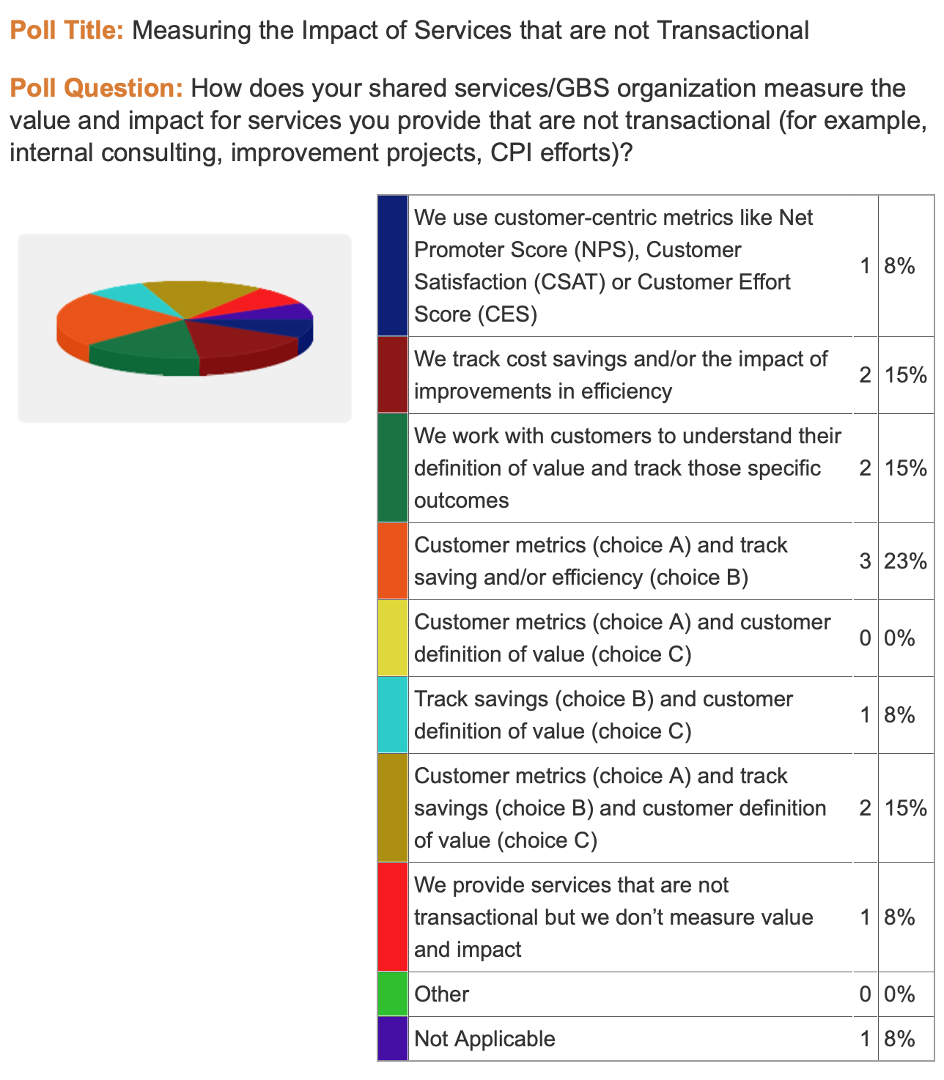
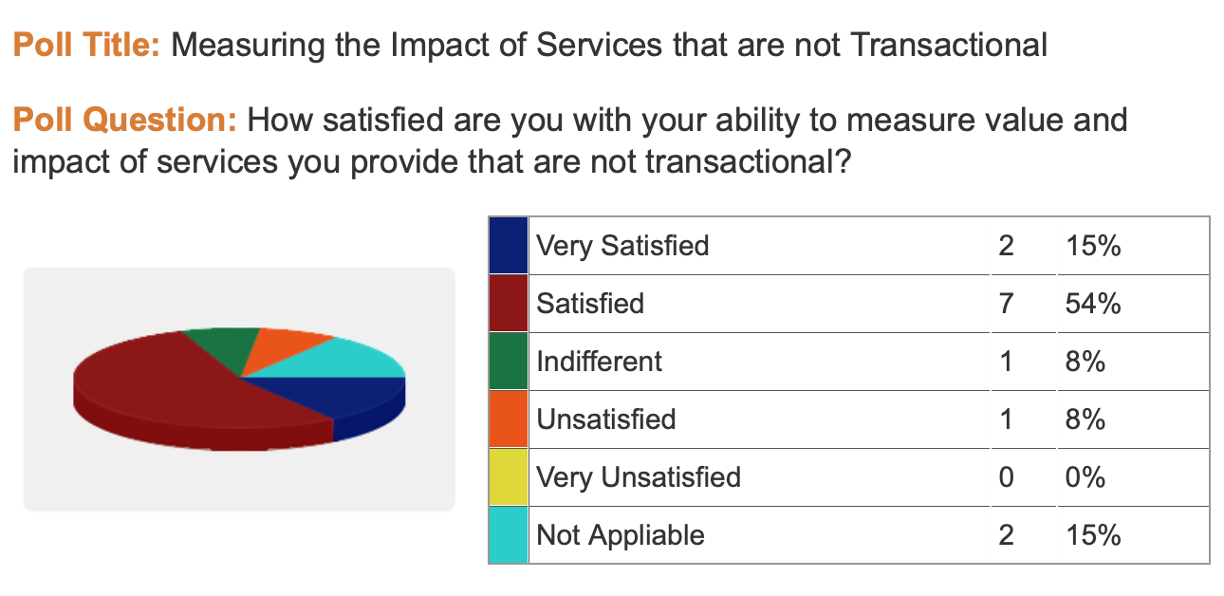
A poll related to the Peercast topic was created to better understand how value is measured for services that are not transactional in nature. The first poll question look at the different approaches to measurement, and the second poll question looked at the level of satisfaction.
The first poll examined the use of different approaches, either separately or in combination with other approaches. The results indicate that 46% of member companies use either Net Promoter Score (NPS), Customer Satisfaction (CSAT) or Customer Effort Score (CES) as one of their methods, and 38% of companies track cost savings and/or the impact of improvements in efficiency, and 30% of companies work with their customers to understand their definition of value and track those specific outcomes. Only 8% indicated that they did not measure value and impact of non-transactional services.
Regarding satisfaction, 69% report that they are either satisfied or very satisfied.
Some comments from members:
- Our customers are not shy and we usually hear right away if something is not working or is too expensive. That is the benefit of allocating the costs at the transactional level. Every step has skin in the game.
- The tracking often depends on the ask or situation as well as the scale. Small ad hoc consults are not measured, while larger efforts would have aligned success criteria. Like others, our customers want value from any investment they make.
- We started measuring NPS couple years ago. Start gaining more momentum since last year.
- Cost savings are fairly easy to track and our ability to show the larger Finance organization that we actually can reduce cost (our budget goes down year to year) is an extremely compelling argument to the executive team. Metrics are also good, but at the end of the day if you can ensure escalations are handled timely and effectively while reducing cost, folks are happy.
Key Topics Discussed
Measuring Service Excellence Framework
Person1 discussed the challenges of measuring service excellence in non-transactional services like continuous improvement, where traditional customer satisfaction surveys may not be effective. She outlined a framework that includes value creation, risk avoidance, regulatory compliance, cost avoidance, and productivity improvements. Person2 shared theirs experiences, highlighting the importance of measuring overall performance beyond just efficiencies, and emphasized building credibility to influence decisions about whether to use internal or external resources. The discussion touched on the art and science of measuring and quantifying the impact of internal improvements versus external consulting, as well as the need for transparency and storytelling to build credibility and demonstrate value.
Process Metrics for Productivity Improvement
The meeting focused on discussing process-level metrics and their importance in measuring productivity, cost, quality, and cycle time within organizations, particularly in GBS or shared services. Person1 emphasized the need for metrics to drive action and improve decision-making, while Person2 shared a success story of improved planning processes. The discussion covered how to choose and implement metrics, with an emphasis on setting targets and ensuring that measured areas are impactful. The conversation ended with a call for attendees to share their perspectives and ask questions about the measurement process.
Service Metrics and KPI Systems
Person1 explained that their organization reviews service metrics quarterly through Tableau, with some teams using manual systems like Smart-sheets or Excel while others have automated reporting. Alco shared that their company recently completed a transformation from AS400 to Oracle and centralized their GBS organization in India, implementing a comprehensive KPI system with 30 metrics across OTC, purchase to pay, R2R, and acquired to retire streams, which are reported weekly to the CFO and available daily through online dashboards in Power BI.
BPO Measurement Practices and Metrics
The group discussed measurement practices in business process outsourcing (BPO) and internal operations. Person2 shared that their company focuses on daily and weekly measurements, prioritizing quality and cycle times, with cost becoming more critical later. Person1 explained that their company manages SLAs with vendors and includes third-party performance in quarterly reviews alongside internal team metrics. The discussion highlighted the importance of daily management systems and the need for both internal and vendor performance measurements.
Supplier Governance Models Comparison
Person3 described their supplier management approach, including monthly governance calls with senior leadership for their largest supplier and quarterly reviews for smaller suppliers, with SLAs ranging from 6 to 35 metrics per supplier area. Person 4 explained their formal third-party governance model, which includes metrics for performance, financial management, and compliance, along with internal monitoring through a data lake system that tracks various metrics from their SAP system.
Data Automation and Analytics Transformation
The discussion focused on data automation and analytics capabilities, with Person4 explaining how their organization has transformed from manual Excel-based processes to a highly automated system using data lakes and Power BI, refreshed daily. The team discussed challenges around custom dashboards and data governance, with noting that while people often request customized views, maintaining a single source of truth is crucial. The conversation concluded with a discussion about exploring end-to-end performance measurement in GBS, with person2 noting that their company is still in the early stages of implementing Oracle and working on streamlining their KPIs, while person1 mentioned their company is exploring AI capabilities through their internal Chat platform but hasn’t fully defined its future state.
End-to-End Process Efficiency Measurement
The meeting focused on the challenges and importance of measuring end-to-end process efficiency, particularly in finance and procurement processes. Person2 emphasized the need for a comprehensive end-to-end measure, highlighting the complexity of integrating various systems like EDI, Oracle, and payment systems. Person1 and Person4 agreed on the need for clear, simple metrics that drive improvements across the ecosystem, with addition discussion regarding the added complexity of involving third-party service providers in BPO situations. The panelists stressed the importance of engaging all levels of the organization in the measurement process to ensure accountability and drive improvements.